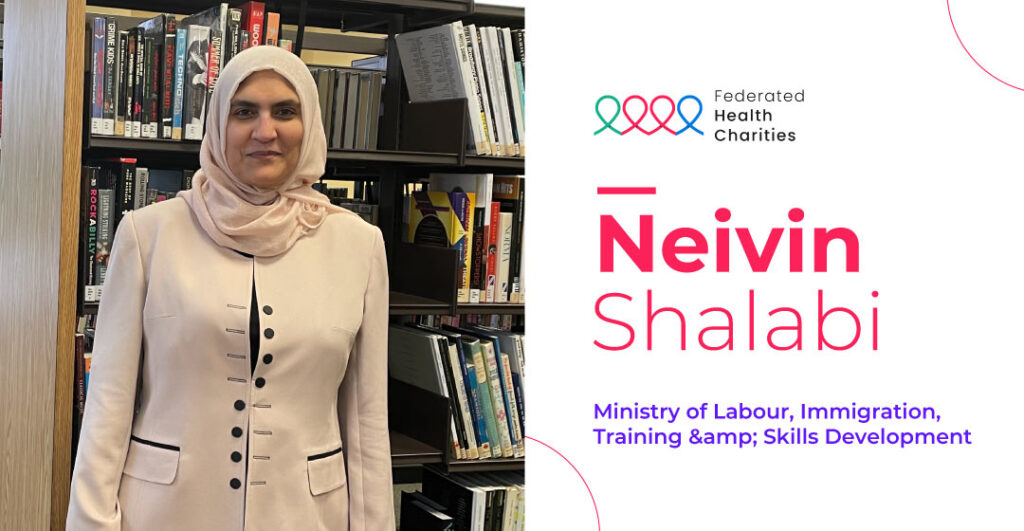
Neivin Shalabi
Ministry of Labour, Immigration, Training & Skills Development
I often say that my connection to Federated Health Charities feels less like a choice and more like something that flows naturally from who I am. It comes from my faith, my culture, my mother, my research, my values – truly every layer of how I see the world.
Growing up as a Muslim girl in an Arab country profoundly shaped me. In Islam, caring for vulnerable groups isn’t optional; it is a calling. You protect people’s dignity. You show up for them. You do good quietly, sincerely, and with the belief that great reward – spiritual and human – lies in helping someone find hope again.
The person who has taught me how to live these values-not just believe in them-is my mother, Rokaia Saleh. She is my best friend and mentor. She is truly the heart of our family. Everyone loves my mom. She has a presence that shines brightest when things get difficult – like a precious stone that glows under pressure. My mom is the person who stands with others, without hesitation.
I grew up watching my mom quietly set aside a portion of her salary each month for charity – always, without fail. When I became old enough, she told us she had been doing this our entire lives so that we would grow up believing that giving was simply part of how one moves through the world. And it worked. Other people’s happiness feels like an integral part of my own wellbeing. Caring is not an action I take – it is something I am.
Volunteering became a way for me to honour these values. In Egypt, I threw my heart into work with a major NGO, Message (رسالة), supporting sick children, orphans, and families in poverty. I eventually co-led the committee overseeing programs for orphans – recruiting and coordinating volunteers, planning events, making sure every child felt seen. I was more than a volunteer; I felt responsible for making things better.
Later, during my postgraduate studies in the United States, I joined Habitat for Humanity. Seeing families receive a safe place to live reinforced why giving matters. These experiences shaped my research interests in community engagement and inclusive excellence which informed my work in knowledge mobilization and building reciprocal relationships.
So, when I learned about Federated Health Charities, it felt instantly right to me. As a professor my academic research background on community engagement and service-learning helped students connect classroom theories to real-world needs. I sent them to NGOs, bridging gaps, leveraging university resources in service of communities that struggle with limited capacity. Connecting with FHC when I joined the OPS felt like a natural extension of everything I’d been doing my entire career.
What I love about FHC is that it recognizes the profound value of collective giving. Even wealthy societies benefit when we reduce the gap between those who have and those who do not. Illness doesn’t discriminate. Poverty doesn’t wait politely. People become sick or vulnerable for reasons they never choose. And when you are weak, sick, and also financially struggling, life becomes unbearably difficult. Helping to ease that burden is, to me, the mark of a good society – one that treats its most vulnerable members with dignity.
When I was invited to join the Advisory Council, it felt like the right next step. I believed I had something meaningful to offer – not just perspectives on fundraising, but insights into human motivation, equity, and incentives that go beyond money. I wanted to help mobilize our collective power, to widen the impact we can make together.
FHC gives meaning to my work as a public servant. It connects who I am privately to what I do professionally. When I served as Divisional Chair in my ministry, I used simple communication strategies – like my weekly “What? So What? So Now What?” campaign emails – to keep colleagues engaged. It warmed my heart when people told me they began using the structure in their own communications.
Some of my proudest moments with FHC come from quiet conversations – speaking 1:1 with colleagues, hearing how they involve their children, how they make donations in honour of loved ones. Seeing parents pass on the values of generosity to their children fills me with hope. That is legacy. That is culture-shifting work.
I believe deeply in consistency. It’s not about the amount one gives; it’s the commitment. Consistent monthly donations allow our 21 partner charities to plan, to feel safe, to support people who don’t have the job security many of us enjoy in the OPS.
Volunteering with FHC has made my work richer. Even on days when I was exhausted after hours of campaign activities, I felt joy – pure joy. The kind that tells you you’re living your values and building something meaningful.
To me, this is not just volunteering. This is who I am. And I am grateful that Federated Health Charities gives me a place where all the parts of my life – my upbringing, my beliefs, my scholarship, my privilege, and my passion – come together to help build a better world.